Detritus
…contains pieces of dead plants, dead animals and animal wastes (feces or poop). It is usually black or brown. Although detritus is dead, it is crawling with living microscopic critters….
…contains pieces of dead plants, dead animals and animal wastes (feces or poop). It is usually black or brown. Although detritus is dead, it is crawling with living microscopic critters….
Algae live in water and come in many shapes and sizes. They are shades of green, golden brown, red, or brown. Like other plants, algae are made up of cells…
Bacteria are black or clear unless you stain them with special dyes to see them better. Bacteria are made up of one cell. It can be round, long and thin,…
Protozoa are single-celled animals that come in many shapes and sizes. The most common shapes are round, oval, bell-shaped and slipper-shaped. Protozoa are clear. They become the color of the…
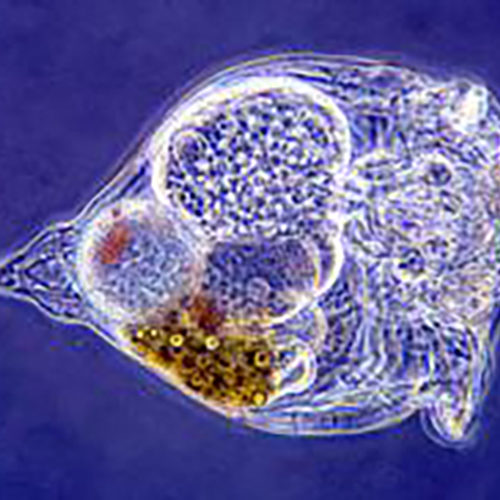
Rotifers are the smallest animals. Their outer coat looks like clear glass. Sometimes this glassy coat is covered with spines or spikes. Rotifers have a ring of cilia (hairs) at…
The most remarkable feature of the California Tiger Salamander is its striking coloration. Adults are black with yellow or cream spots. The body is thick, with a rounded nose and…
…participate in hands-on experiments, including observing microscopic organisms, dissecting, and investigating nature near where students lived. Students were encouraged to use higher-level thinking skills and work collaboratively. Throughout her teaching…
…know what you’ll see in nature!” Whether spotting wildflowers, peeking at microscopic invertebrates, or meeting the native critters in Critterville, the experience feels fresh and exciting every time. Connecting with…
…by Ryuichi Sakamoto, Bernard Hermann and Cults Percussion Ensemble. Exploring Vernal Pool Microlife (IVP) Much of the food web action in wet phase vernal pools happens on a microscopic level….